


PREMIUM SALTS
VON RED SEA
Why are so many aquarists successful with Red Sea premium salts?
The answer lies in a combination of rich natural ingredients, scientific innovation based on three decades of research and uncompromising responsibility.
The source of our salt is the Red Sea, a protected arm of the Indian Ocean between East Africa and the Arabian Peninsula. This is one of the most barren regions on earth, but beneath the blue waters lies an unusual oasis full of life, reefs and coral formations. Our premium salts are made from sodium chloride extracted from the living coral reef itself - resulting in an unparalleled homogeneity of all trace elements in every single grain of salt.
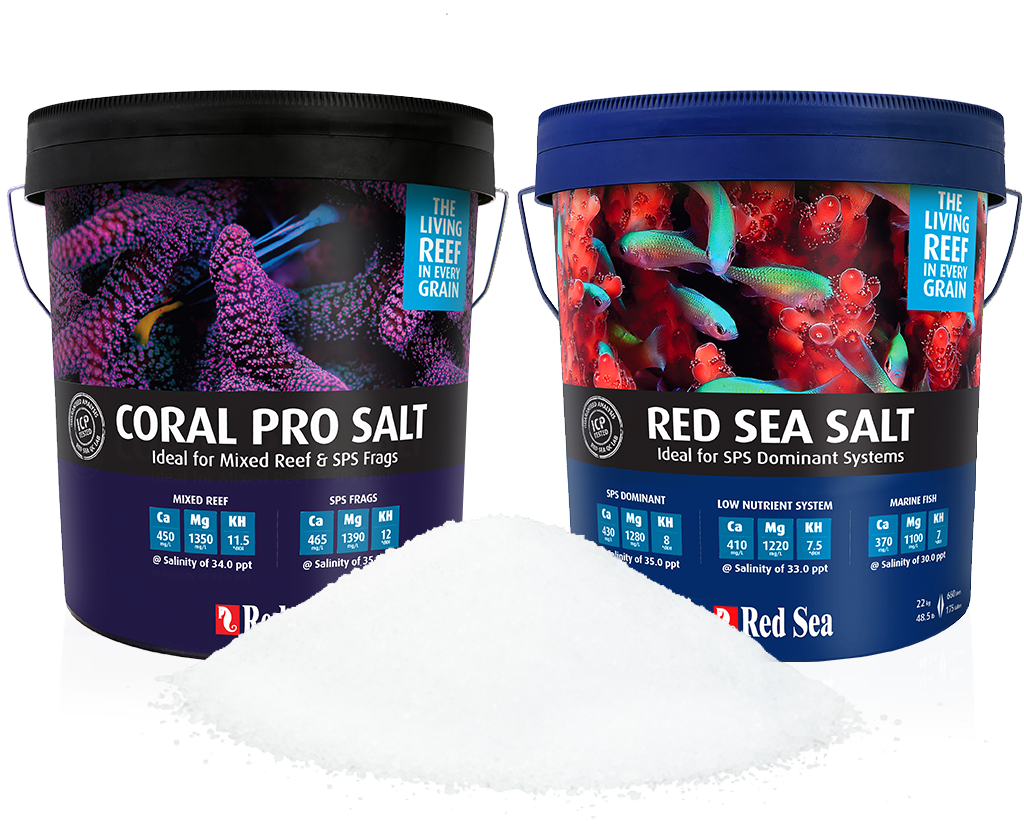
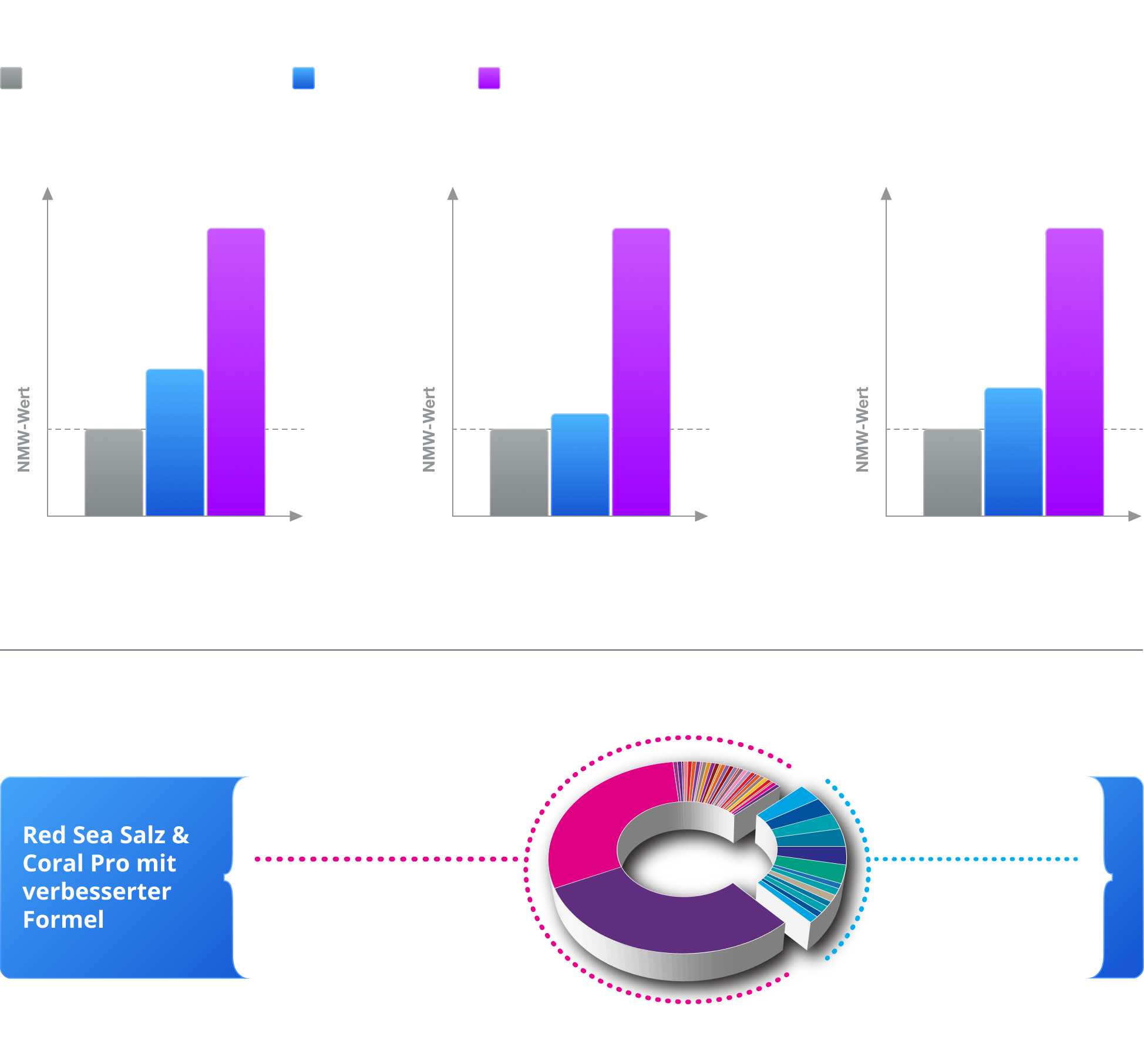
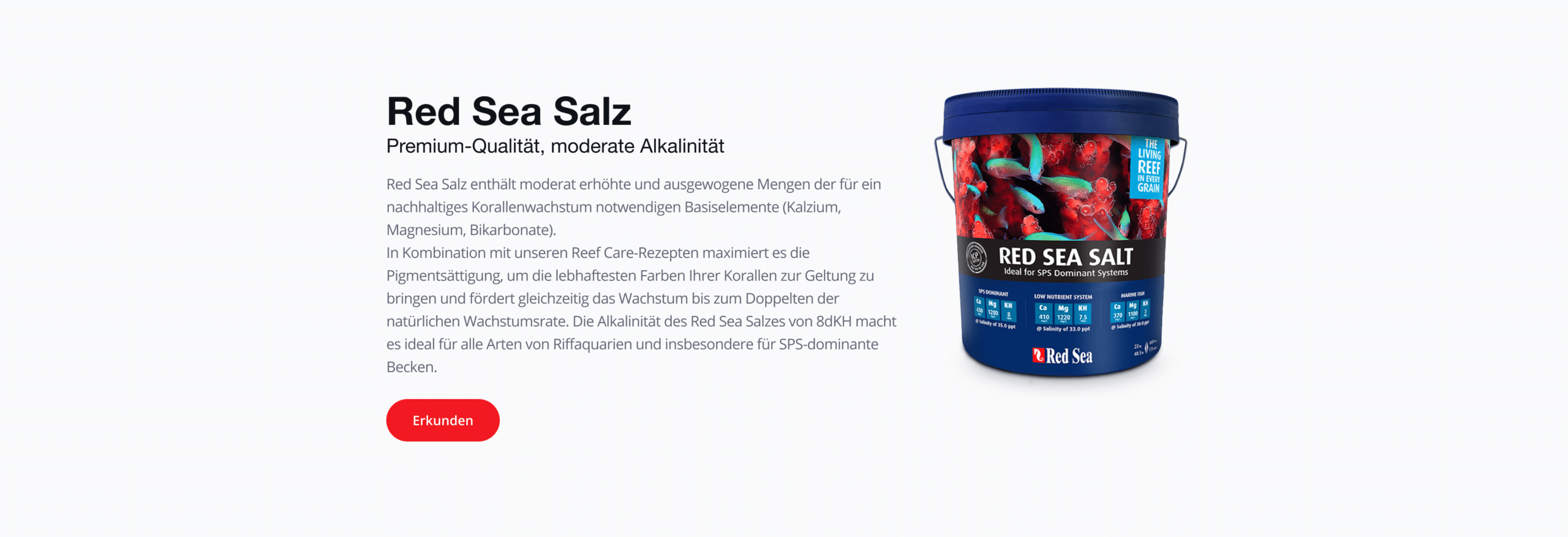
Thanks to our long-term research into the needs of corals, we have found that natural seawater alone is not enough to maintain a stable artificial reef environment. Aquariums do not have the vast replenishment resources of the ocean and therefore require a supplement of elements from us. In addition, our research has shown that only a very specific ratio between the basic elements ensures sustainable growth and a healthy coral skeleton. Therefore, we combine our two salts in accordance with these ratios - with balanced and increased levels of the basic elements.
Our strict ICP-certified quality control puts the finishing touches on everything and guarantees homogeneity and continuity from one salt blend to the next.
How we extract our salts:
The natural water of the Red Sea is channeled through several shallow pools where it undergoes a natural evaporation process under the desert sun. In the first pool, the seawater reduces its natural salinity from 40ppt to approximately 250ppt, removing all calcium and metal residues.
Evaporation continues in subsequent basins, resulting in the precipitation of sodium chloride and leaving other ions such as magnesium and potassium in a concentrated brine. In the final stage of the evaporation process, the sodium chloride is washed and dried, removing all remaining organic and inorganic impurities.
The result is pristine white sodium chloride crystals containing 45 of the elements found naturally in the waters of the Red Sea. This element-enriched sodium chloride, free from excessive levels of heavy metals or organic matter, makes up over 72% of the Red Sea salts' content and provides a level of homogeneity that is difficult to achieve using artificial processes.
Some other interesting facts:
skeleton formation
Corals build about 90% of their skeleton by combining calcium and carbonate ions from the water to form aragonite (CaCO3). The rest of the skeleton is made up of magnesite (MgCO3), strontianite (SrCO3), calcite (a more brittle crystal structure of CaCO3), CaF2, and other minor and trace elements. The basic elements complement each other in the formation of the coral skeleton. However, if any of them is not present in the correct proportion, it quickly becomes the limiting factor for healthy coral growth.
Accelerated coral growth
Corals must invest energy in transporting the elements necessary for skeletal growth from the surrounding water through their soft tissue. Increased levels of the base elements create a more positive ionic pressure, making this process much more efficient (less energy per gram of skeleton). Therefore, balanced, increased levels of the base elements lead to accelerated coral growth rates.
The Effects of Unbalanced Base Elements
At low Mg²+ and/or Sr²+ levels, the coral skeleton develops with a higher proportion of calcite, making it more brittle and susceptible to damage, while low magnesium or high calcium levels can lead to alkalinity drops. High alkalinity with calcium in the saturation range causes precipitation, leading to low calcium levels.
Red Sea Salts in Comparison
 Deutsch
 Български
 Čeština
 Dansk
Dansk Nederlands
 English
 Eesti
Eesti Suomi
Suomi Français
 Ελληνικά
 Magyar
 Italiano
 Lëtzebuergesch
 Norsk bokmål
 Polski
 Română
 Русский
 Slovenčina
 Slovenščina
 Español
 Svenska
 Türkçe