


DipX ®
DipX is a highly effective dip for safely introducing new corals and live rock into your aquarium.
A simple 15-minute dip in DipX before adding a new coral to the aquarium will drive away unwanted hitchhikers and maintain the safety of your reef.
New corals often come with unwanted "hitchhikers" hidden deep in the crevices of the coral. These diverse tiny creatures are often invisible to the naked eye and once in the tank, they can migrate to other corals, causing damage to your delicate reef ecosystem.
Over the years, reef hobbyists have used common bathing solutions such as fresh water, iodine, and even household disinfectants, which often repel some of the hitchhikers, but not all.
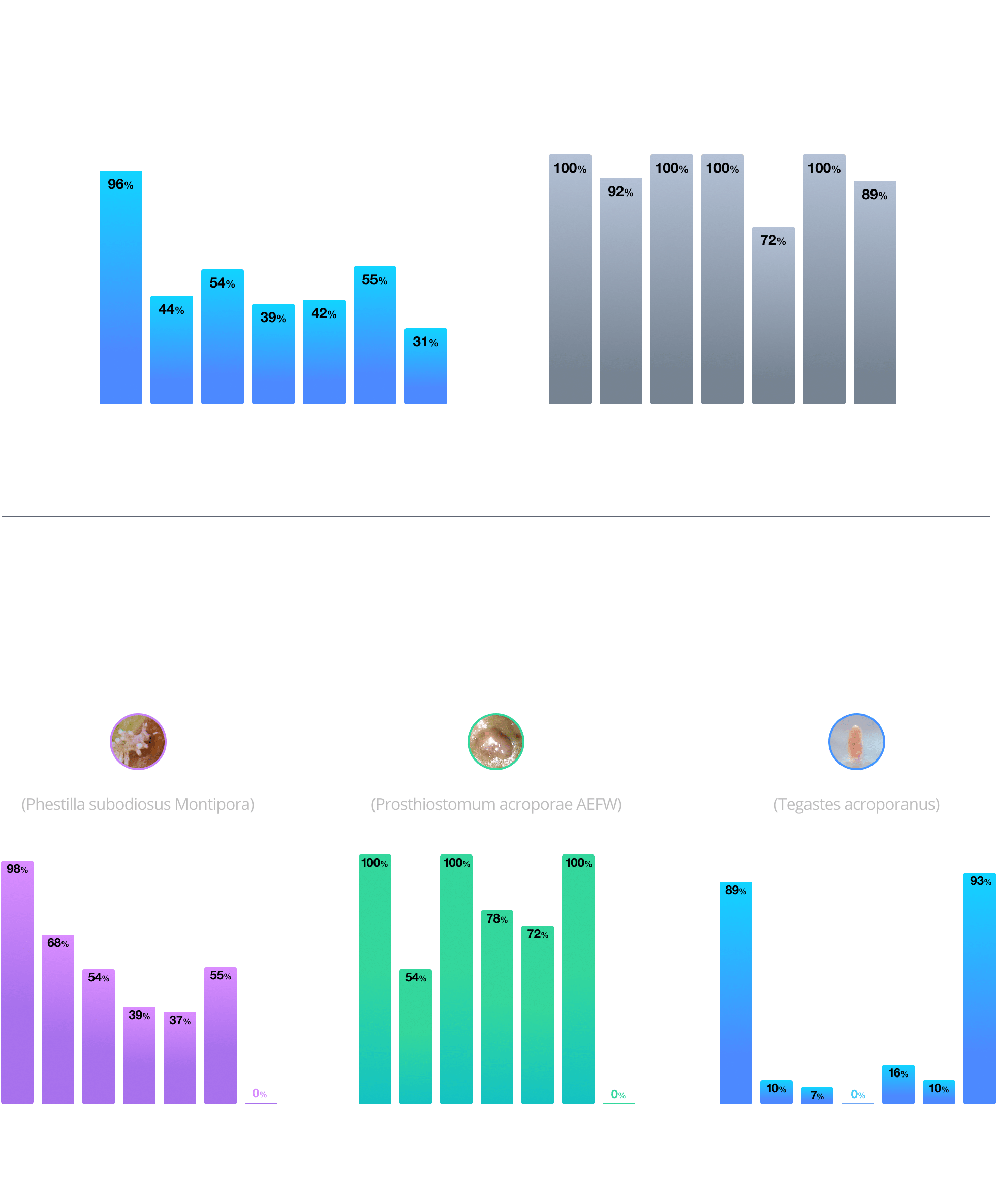
Over the past few years, we have cultured tanks with infected corals and compared a wide range of commercially available dips and other repellent ingredients to investigate both their effectiveness and overall safety for the corals.
The result is DipX - a unique blend of essential oils, without inorganic disinfectants. Our tests have shown that DipX is completely safe for all types of corals and more effective than any other solution we have tested.
Corals bathed in DipX still repelled unwanted hitchhikers even though they were previously dipped in other solutions. On the other hand, corals dipped in other solutions after bathing in DipX did not repel anything.
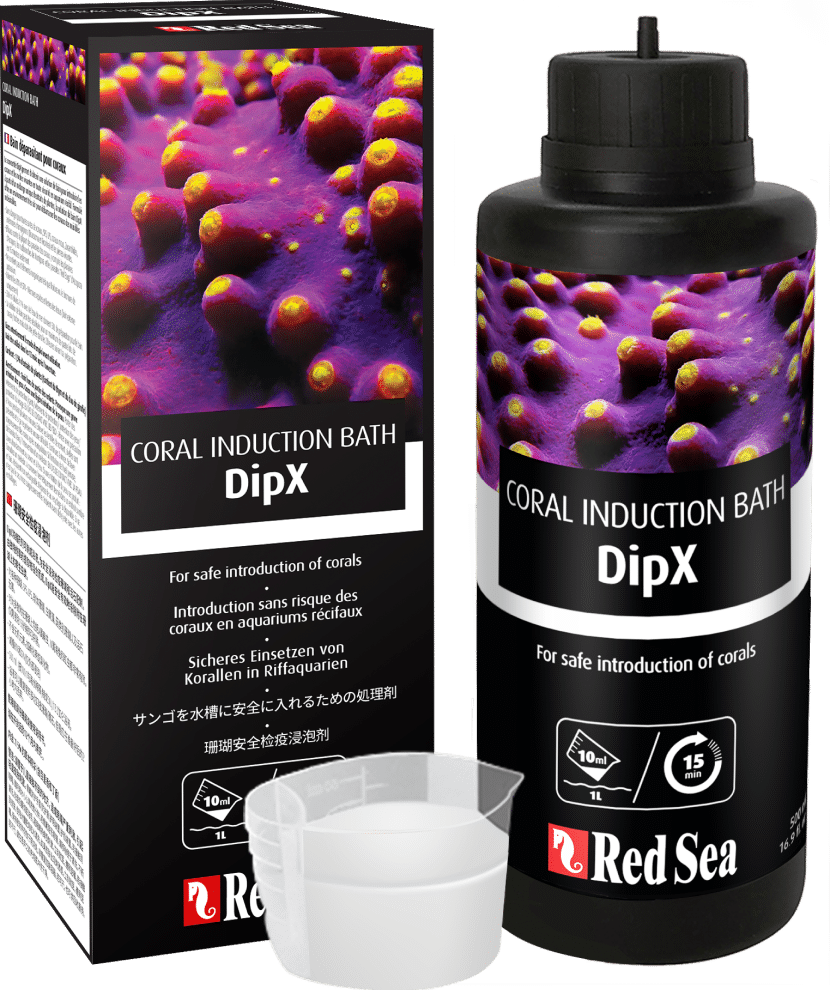
Characteristics
- Safe for all types of corals: SPS, LPS, soft corals, encrusting anemones, disc anemones (Discosoma and Ricordea) and live rock.
- Effectively repels Acropora-eating flatworms, Montipora-eating nudibranchs, Acropora Red Bugs and other coral hitchhikers.
- Slows down slow and rapid tissue necrosis (external bath only).
- Free from inorganic elements such as potassium iodide or bromide.
- Easy to use, reliable and cost-effective



essential oils


to apply
Test results of DipX compared to other solutions*
Why do corals have "hitchhikers"
In nature, numerous species of coral-related invertebrates live on corals and reef rocks and are collectively referred to as "opportunistic inhabitants". The most common groups of these opportunistic inhabitants include crustaceans, helminths (worms), echinoderms, nudibranchs and snails.
In most cases, the inhabitants benefit from the host without harming it, in other cases (such as trapeziidae crabs in Acropora) both host and inhabitants benefit from the relationship. However, there are some inhabitants that harm their host by feeding on it. In their natural habitat, all of these opportunistic inhabitants are relatively rare due to the lack of nutrients and natural enemies.
When corals are moved from one environment to another, these opportunistic inhabitants remain with their coral hosts and become accidental hitchhikers.
Do you suspect that one of your corals has a hitchhiker? Check out the hitchhiker identification table
Why do corals need to be bathed
“There are no practical methods to remove opportunistic inhabitants from an established reef aquarium.
While not all random hitchhikers are necessarily bad for an artificial reef, some of them quickly become "uninvited guests." Therefore, it is strongly recommended to adopt a "better safe than sorry" policy and try to prevent them from entering. However, once they are in the system, affected corals and live rock must be removed and treated one by one.
Careful inspection of corals should be part of regular maintenance of a reef aquarium so that any signs of soft tissue damage or discoloration can be identified and investigated as soon as possible. Early detection of hitchhikers is the most effective way to prevent an uncontrolled outbreak that has the potential to damage the entire reef."
Instructions for use
- Pour DipX into an empty container. Make sure the container is clean and dry.
- Use 10 ml of DipX (diluted 1:100 with aquarium water) to make 1/0.26 gallon of bath mix.
- Do not place your new coral or live rock in the container for more than 15 minutes.
- The bathing solution can be used for up to four coral/stone applications, but should be disposed of within 2 hours of preparation.
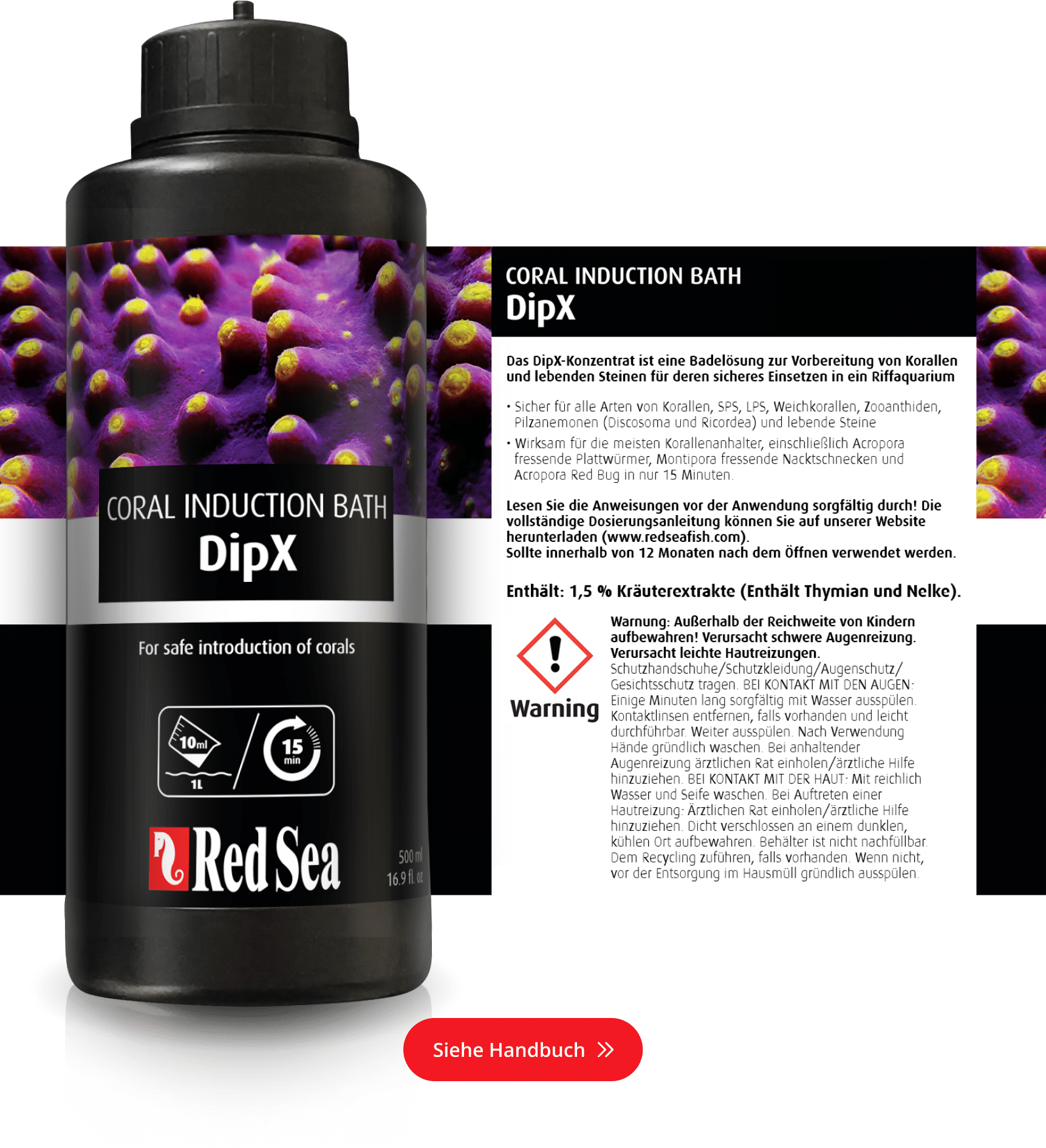
package size/volume
- 100 ml introduction
- 250 ml
- 500 ml
- 5 L
 Deutsch
 Български
 Čeština
 Dansk
Dansk Nederlands
 English
 Eesti
Eesti Suomi
Suomi Français
 Ελληνικά
 Magyar
 Italiano
 Lëtzebuergesch
 Norsk bokmål
 Polski
 Română
 Русский
 Slovenčina
 Slovenščina
 Español
 Svenska
 Türkçe